 ToneBird
How to Email Your Academic Advisor From First Contact to Follow-Up
Examples for first contact, course questions and followups, plus how to address your advisor and choose between email and an appointment.
 By Xinran Zhao
 Reviewed & edited byMonica Cheng
Give your academic advisor four things: who you are, the relevant situation, your specific question and any real deadline. A short email can still take much longer than it should. You know what you need to ask, but then you start wondering whether “Hi” sounds too casual, whether you should say “Professor,” how much background to explain, and whether asking directly will sound demanding.
- Ask about a course
- Arrange a first meeting
- Follow up when there is no reply
- Reply after your advisor responds
Academic advisor email example: a course question
Here is a course registration example. Jordan is a staff advisor whose office uses first names. Replace the student details, course numbers and term with your own.
Subject: COMM 310 prerequisite question for Spring 2027
Hello Jordan,
My name is Maya Chen, and I am a second year Communication major. [Student ID, if your advising office requires it.]
I am planning my Spring 2027 schedule and noticed that COMM 310 lists COMM 200 as a prerequisite. I completed an equivalent course at my previous institution, and the transfer credit is already showing on my degree audit.
Could you let me know whether that credit satisfies the prerequisite, or whether I need to submit a separate approval form?
If this would be easier to discuss in a meeting, I am happy to schedule one.
Thank you for your help,
Maya Chen
The advisor does not have to hunt for the actual question. The subject identifies the issue, the body includes the context that changes the answer, and the request makes the next step obvious.
The transfer course appearing on a degree audit does not, by itself, answer the prerequisite question. The email asks the advisor to confirm that distinction rather than assuming the registration system is wrong.
Your first email to an academic advisor
Introduce yourself with your name, year and program, then explain why you are contacting this person. If they are your assigned advisor, say so. If another office referred you, name that referral. You do not need to introduce your entire academic history before stating what you need.
For a first meeting about your course plan, check the advising page for a booking link. If the office asks you to arrange an appointment by email, you could write:
Subject: First advising appointment for Spring 2027
Hello Jordan,
My name is Maya Chen, and I am a second year Communication major. Your name is listed as my academic advisor. I would like to review my course plan for Spring 2027 and check which requirements I should prioritize. Could you let me know how to book an appointment?
Thank you,
Maya Chen
This version asks for an appointment rather than asking the advisor to build a degree plan by email. Add your student ID or actual available times if the office requests them.
When you know what to ask but keep rewriting the opening, ToneBird can help you draft your first message to an advisor or another new contact. It works as your AI reply assistant across email, Slack, LinkedIn, WhatsApp and other messaging apps. Give it the purpose, the facts that need to stay in the message and the tone you want.
How to address your academic advisor
This is one of the easiest places to start overthinking because there is no single title that works for every advisor.
Are academic advisors professors?
Not always. An academic advisor may be a faculty member or professional advising staff. Seattle University’s advising glossary, for example, distinguishes the two roles. Check the university directory and advising page before choosing a title.
- If the directory lists Dr. Maya Patel, “Hello Dr. Patel,” uses that title.
- If a faculty advisor uses Professor, “Dear Professor Patel,” is appropriate.
- If no title or preferred greeting is listed, “Hello Jordan Lee,” avoids guessing.
When can you use your advisor’s first name?
Use a first name when the advisor or office explicitly invites it. UConn Pharmacy Advising, for example, asks students to address Lyn and its peer advisors by first name, while giving different guidance for faculty and other staff. Follow the instructions for the person you are contacting.
A reply’s signature can offer a clue, but an explicit preference is clearer. “Please call me Jordan” settles the question; a first name in a signature alone leaves more room for interpretation.
It is easy to spend too much attention on the greeting because it is the first thing you have to write. A 2023 study of student faculty email judgments found that the Greek EFL learners studied tended to focus heavily on formal markers and forms of address while paying less attention to the content and context of the request. The study involved a specific learner population, but the distinction is useful here: getting the title right matters, but it cannot make up for an email that never clearly explains what you need.
Subject lines for an academic advisor email
A subject like “Question” tells your advisor almost nothing. Name the issue so they can see what the email concerns:
- Question about Spring 2027 course registration
- COMM 310 prerequisite question
- Course withdrawal question before October 2 deadline
You do not need to summarize the entire email in the subject line. It only needs to tell your advisor what kind of issue they are opening.
What to include in your advisor email
Your introduction and relevant academic details
After the greeting, include the information your advisor would otherwise have to ask you for in another email.
Depending on the situation, that might include your program, student ID, course number, registration error, degree requirement, or deadline. UC Merced Academic Advising, for example, asks students to provide their full name, student ID, and a brief but detailed explanation of the concern.
You do not need every detail in every email. Include the ones that actually change the answer.
Harder to answer | Easier to answer |
|---|---|
I have a problem with registration. | I am trying to register for COMM 310, but the system says I have not completed the prerequisite. |
Can you help with my schedule? | I am deciding between COMM 520 and COMM 525 and want to confirm which one can satisfy my elective requirement. |
Something is wrong with my credits. | My transfer course appears on my degree audit, but it is not being counted toward my major requirement. |
I need to meet soon. | I need to make a decision before the October 2 withdrawal deadline and would appreciate your guidance before then if possible. |
The stronger versions are not much longer. They simply remove the first round of clarification your advisor would otherwise need to ask for.
A question your advisor can act on
Once you have explained the situation, say what you need.
- For confirmation: “Could you let me know whether this course can count toward the requirement?”
- For advice: “Would you recommend taking COMM 520 this semester, or would it make more sense to wait until I have completed COMM 510?”
Before sending, check whether the advisor can answer your question directly or tell you who can. “Can you help?” leaves the next step open; “Does this credit satisfy the prerequisite, or do I need an approval form?” gives them two concrete routes.
If a real deadline is approaching, name it and ask what is possible. “The registration deadline is today. Could you let me know whether there is still a way to resolve this prerequisite question?” communicates the time constraint without assuming the advisor can approve an exception. Check the office’s listed urgent contact or drop in route as well; sending an email does not guarantee it will be read in time.
When to email and when to book an appointment
Some advising questions fit naturally into one email. Others are easier to solve in a meeting.
Email usually works well for focused questions such as:
- confirming one requirement
- asking about a deadline
- reporting a registration problem
- checking a prerequisite
- asking which office handles an issue
A meeting may make more sense when you are choosing between several academic paths, changing programs, rebuilding a degree plan, or dealing with several connected problems at once.
Before emailing only to ask when your advisor is free, check whether your school already has an appointment system. You may be able to skip an unnecessary round of scheduling messages.
Check who handles the decision, too. Stanford’s faculty email guide, for example, directs requests for assignment extensions to instructors and shows an academic advisor copied where relevant. Follow your school’s process rather than assuming every academic decision belongs to the advisor.
Followups and replies to your advisor
If you have not received a reply
Follow your advising office’s published response window and check any automatic reply before following up. Response times vary: UC Merced SSHA, for example, lists 5 to 7 business days outside peak periods and 7 to 10 during peak periods. There is no single waiting period that fits every office.
When a followup is appropriate, reply in the same thread so the original question is visible. For the prerequisite example, a brief reminder could be:
Hello Jordan,
I’m following up on my prerequisite question below. Registration closes on [date]. Could you let me know whether I should submit an approval form, or contact another office about this?
Thank you,
Maya Chen
Use the actual deadline, and include it only if it matters to the request. If that deadline falls before the office’s response window, use its listed timely support route rather than relying on repeated emails.
If your advisor has already replied
Once your advisor has answered the original question, you can usually keep the next reply short. Repeating the introduction and full course history may make it harder to see what has changed.
Suppose Jordan replies with an approval form and confirms a Friday registration deadline. After submitting that form, this may be enough:
Hello Jordan,
I submitted the prerequisite approval form you sent yesterday. Could you confirm whether I need to submit anything else before Friday’s registration deadline?
Thank you,
Maya
The amount of explanation should shrink as shared context grows. An ongoing advising relationship is not a series of first introductions.
Keep the context for your next reply
As you keep writing to the same person, ToneBird can save context about that contact and your preferred tone. For an advisor, that might mean the form of address you use and the concise, respectful style you prefer. You can build on those preferences instead of explaining them again for every draft.
Later replies also depend on earlier messages in the thread. In the author’s separate Gmail example below, the advisor directs a CPT question to OIS, the Office of International Services. A useful draft acknowledges that referral and the next step, rather than asking the original question again.
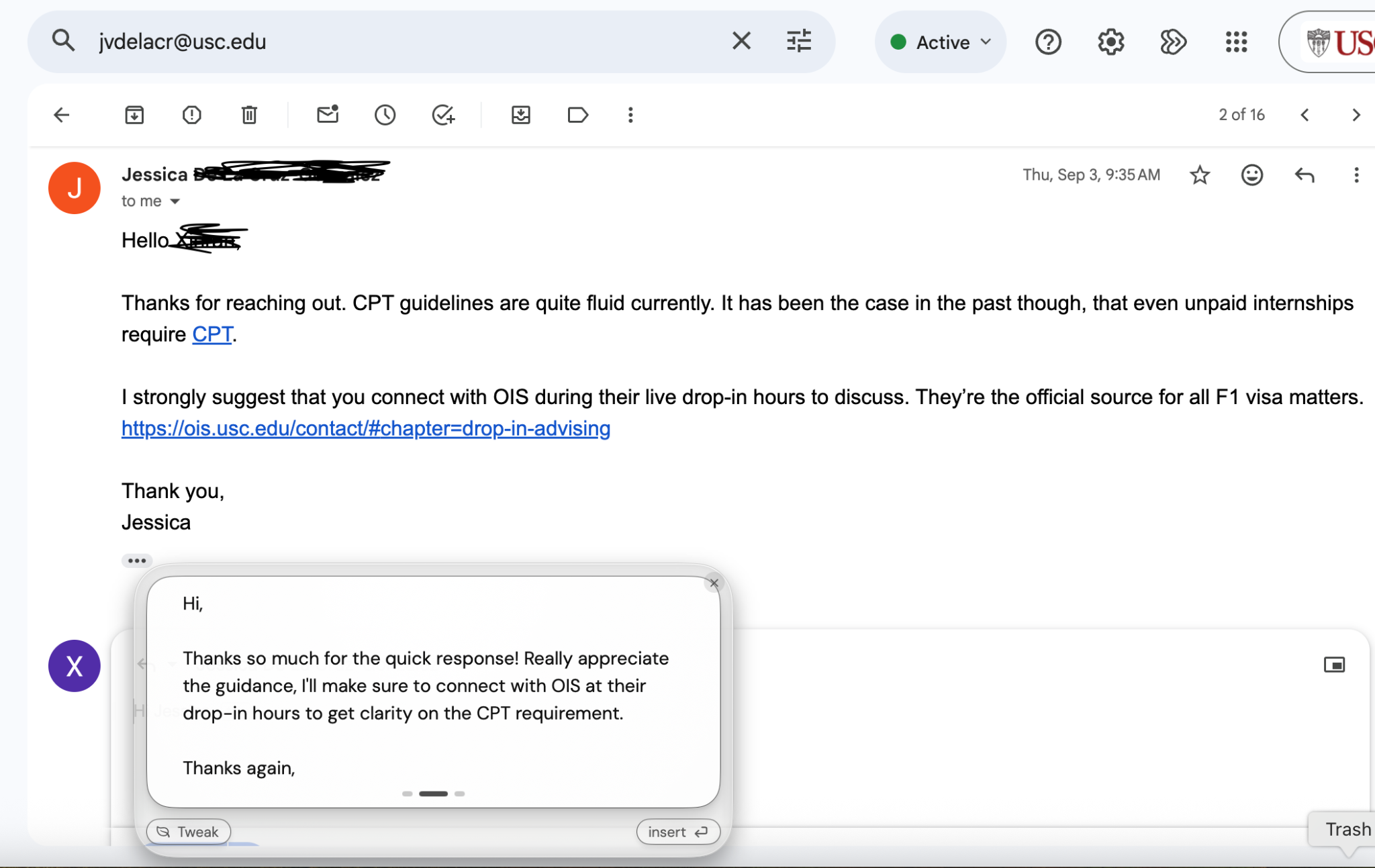
Check whether that next step is one you intend to take. If you only want to acknowledge the referral, you could ask Tweak: “Thank them for the OIS link. Keep it brief. Do not promise a visit yet.” Use Insert to place your chosen draft in Gmail, review it, and send it yourself. The ToneBird support guide explains this flow.
Before sending, check the recipient, course details and deadline against your own records. Make sure the draft only commits to the next steps you intend to take.
Frequently asked questions
Should I email my academic advisor from my school email address?
Check your school’s rules. Some advising offices require messages from the student’s university account; UC Merced SSHA is one example. Use that account when required, rather than treating it as a style preference. It also helps the office identify you and keeps the conversation where your school expects official communication.
Can I ask more than one question in the same email?
Yes, if the questions are related. Keep them together and make each one easy to spot, especially if one answer affects the next. If you have several unrelated questions or the situation needs a longer discussion, a meeting may be more efficient than turning the email into a long list.
Should I attach screenshots or documents to an advisor email?
Attach them when they help your advisor understand or verify the problem. A screenshot of a registration error, a form you are asking about, or a relevant degree audit page can save another round of clarification. Mention the attachment in the email so your advisor knows why it is there, and avoid sending files that are not needed for the question.

Xinran Zhao has a background in writing and journalism. She writes about the messages we overthink and when AI replies help or miss the point, drawing on her experience starting a career in a second language.