 ToneBird
How to Soften Blunt Business English and Still Make Your Point
Make workplace requests less blunt while keeping deadlines, corrections and boundaries clear. Includes five practical before and after examples.
 By Xinran Zhao
 Reviewed & edited byMonica Cheng

To soften a workplace message, keep the action, facts and deadline clear, then adjust how you ask. A routine reminder needs less explanation than a request for extra work. Sometimes the sentence is grammatically correct and still feels colder than you intended.
“Send me the deck by 3.”
“That will not work.”
“You need to fix this.”
The meaning is clear, but when you read the message back, it sounds colder or more forceful than you intended.
The fix is not to add “sorry,” “please,” or extra words everywhere. You want the message to sound less harsh without making the request vague or awkward. In business English, that usually means reducing unnecessary pressure while keeping the action clear.
Five ways to soften blunt business English
When a message sounds too blunt, you usually do not need to rewrite the whole thing. Small changes can lower the pressure while keeping the request visible.
Original wording | Revised wording | Meaning to preserve |
|---|---|---|
Send me the report today. | Could you send me the report today? | Same report and deadline; change the command into a request. |
This is wrong. | This section lists Q2 as 16.8%. The approved figures show 18.4%. Could you update it? | Use this version only when the discrepancy has been checked. Identify the error without weakening a known fact. |
You did not answer my question. | Could you clarify whether the client approved the new timeline? | Use this if client approval was the unanswered question; do not silently change what you asked. |
We cannot do that. | We cannot meet that launch date with the current scope. Could we discuss a later date or a smaller scope? | Keep a firm constraint firm. Do not invent an alternative date. |
Why is this late? | Could you explain what caused the delay and when you expect it to be ready? | Keep the question about the cause; ask for timing as an additional detail. |
The softer versions are not dramatically longer. The goal is not to wrap a simple request in several lines of politeness. It is to remove the part that feels unnecessarily forceful.
Making requests without sounding demanding
Routine requests and extra work
A message can be direct without being rude. Start with what was already agreed and how much new work you are asking for.
A 2025 study of workplace email requests found that, in the scenarios it tested, how much effort or inconvenience a request created had a stronger effect on directness than hierarchical rank. The study compared Korean EFL employees and American employees using six written workplace scenarios. Direct requests could be appropriate in routine situations; this was not a test of how every recipient reacts to a real email.
That gives you a more useful rule than “always be indirect with a manager” or “always add more polite phrases.”
Suppose a teammate agreed to send an existing deck by 3. A reminder can be simple:
Could you send me the deck by 3 as planned?
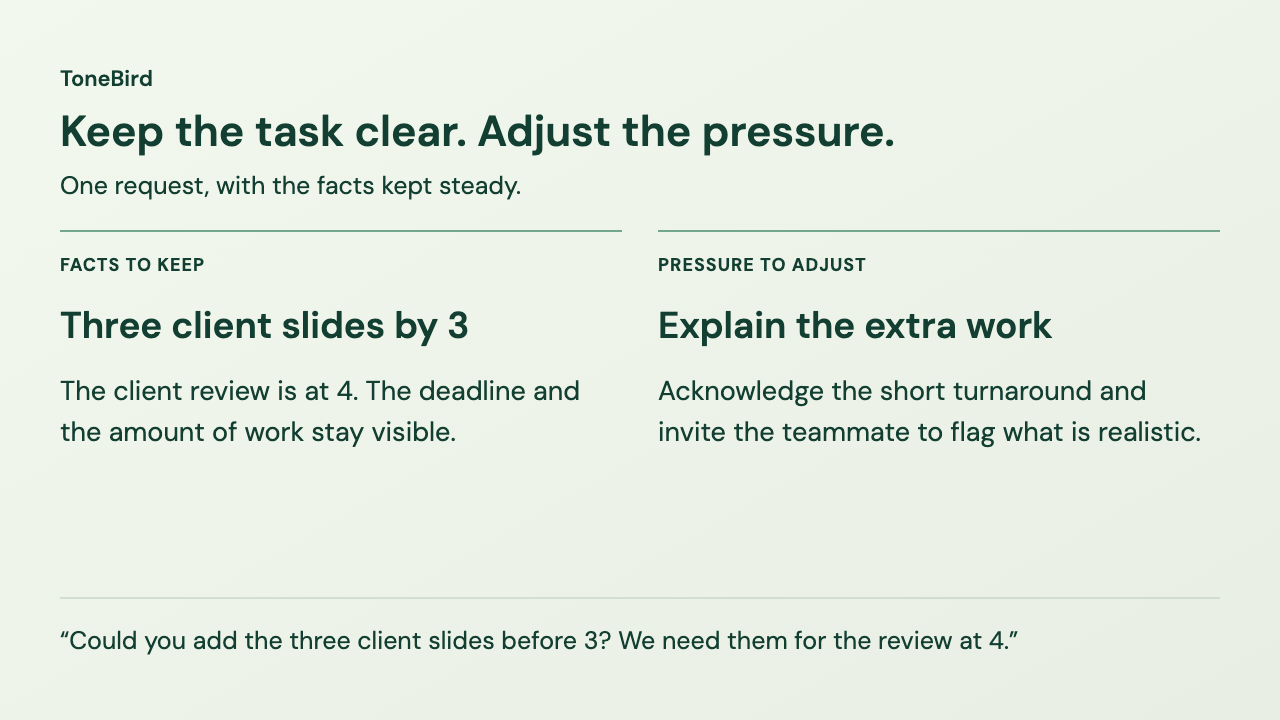
Now suppose you need three new slides by the same time and have not agreed that extra work. The deadline is unchanged, but the burden is different:
Could you add the three client slides before 3? We need them for the review at 4. I know this adds work today. If that timing is not realistic, let me know which slides you can finish so we can adjust the review.
The second request needs more explanation because it adds work. The reason and the option to flag a conflict help the teammate respond; extra politeness words alone would not resolve the workload.
Give the deadline a useful reason
A short reason can often soften a request better than several polite sounding fillers. It tells the reader why the request matters and makes the pressure feel connected to the work rather than to your mood.
Blunt:
Please send the revised numbers by noon.
Softer:
Could you send the revised numbers by noon? I need to include them in the client review at 2.
The reason gives the deadline a purpose. It no longer sounds like an arbitrary demand.
You do not need to explain every routine request. Add context when it helps the other person understand why the timing, change, or favor matters.
This is especially useful when you ask someone to move a deadline, take on extra work, change an agreed plan or do a favor outside their usual tasks.
The bigger the ask, the more useful a short explanation becomes.
Keep a firm deadline firm
Changing “send this” to “could you send this” changes the delivery. It does not change whether the deadline can move. For an agreed deadline, keep the time and explain its purpose:
Instead of:
Please send this as soon as possible.
try:
Could you send the revised deck by 3 today? We need it for the client review at 4. If that timing is not realistic, let me know as soon as you can.
This keeps 3 pm as the requested deadline. Asking someone to flag a conflict gives you a chance to resolve it; it does not mean any later time is automatically acceptable. If the time is negotiable, say so and ask what they can offer.
When “please” still sounds demanding
Adding “please” can help, but it does not automatically turn a forceful sentence into a warm one.
Compare:
Please fix this today.
with:
Could you update this today? We need the new version for the client review at 4.
A workplace email corpus study from UCL found that the use of “please” varied with factors such as request type and relationship. That is a useful reminder that one politeness word is not a universal fix for tone.
If “Please fix this today” still sounds too forceful, check whether the action is specific, the reason is clear and the workload was agreed. “Please” cannot settle those questions for you.
When politeness buries the request
There is another common problem. You try so hard not to sound rude that the request disappears.
Too soft:
Sorry to bother you. I just wanted to ask if maybe you might have a chance to send the report sometime today, if possible.
Clear and polite:
Could you send the report today?
If today is flexible, you can add: “If that timing is difficult, let me know what works.” If today is a firm deadline, keep it firm and ask the person to flag a conflict as soon as they can.
The second version is still considerate, but the reader does not have to search for the action.
Words such as “just,” “maybe,” repeated apologies, and several layers of uncertainty can make a straightforward business message harder to process.
For a genuinely formal request, the British Council gives expressions such as:
I would be grateful if you could...
That wording can make sense in a formal situation. It does not need to become your default sentence every time you message a coworker.
Correcting errors and disagreeing with a plan
Blunt business English often feels harshest when you disagree, correct someone, or point out a problem.
Name the issue and what needs to happen next. That gives the recipient something to respond to without turning the disagreement into a judgment about them.
A confirmed error or a calculation to check
Blunt:
You are wrong about the numbers.
Softer:
I am getting 18.4% for Q2, while the deck shows 16.8%. Could we compare the calculations?
If you have already checked the approved figures, use the firmer correction in the table. If you are still comparing calculations, say that. A considerate tone can carry either a confirmed fact or an open question.
Disagreeing about a plan
Blunt:
This idea will not work.
Softer:
This will not work with the current timeline. Could we review the scope or agree a later launch date?
The softer versions still disagree. They do not hide your position. They simply show what the problem is and give the conversation somewhere to go next.
That is often more useful than trying to make the disagreement disappear behind polite language.
Saying no while keeping the boundary clear
A softer refusal still has to refuse. “That might be a bit difficult” can leave the recipient unsure whether you have accepted the task.
For a client asking for an extra page by Friday, you could write: “Friday’s delivery covers the pages we agreed on. We can discuss the extra page separately.” Use the second sentence only if you are open to that discussion. You do not need to offer an alternative you cannot deliver.
For a request you simply cannot take on, “I cannot take this on today” is a complete boundary. Add a reason if it helps the person plan. An apology or a warmer opener should not turn it into a promise to find time.
Adjusting tone for the person
You probably do not write to a close teammate the same way you write to a new client.
That does not mean one relationship always requires formal language. It means the right tone depends on the person, the history of the conversation, and what you are asking for.
A teammate you work with every day may be perfectly comfortable with:
Can you send me the latest version?
A new client may benefit from a little more context.
A large favor may need more flexibility even when you are writing to someone junior to you.
When you are writing in a second language, you may know the answer but keep checking whether it sounds abrupt. ToneBird can help turn that answer into a draft in email, Slack, LinkedIn, WhatsApp and other messaging apps with supported text fields. You can use it as your AI reply assistant for an ongoing conversation or to draft your first message to a new contact.
For the deck request, tell it what must stay: three slides, the agreed 3 pm deadline and the review at 4. Then ask for a more considerate wording. Its personalized tone preferences can guide how direct or warm the draft sounds; they should not turn a deadline into an optional target or agree to extra work.
Check that the draft keeps the same task
In the author’s ToneBird example below, a teammate is asked to revise three slides by 3 for a client meeting at 4. The original request and suggested reply are visible together.
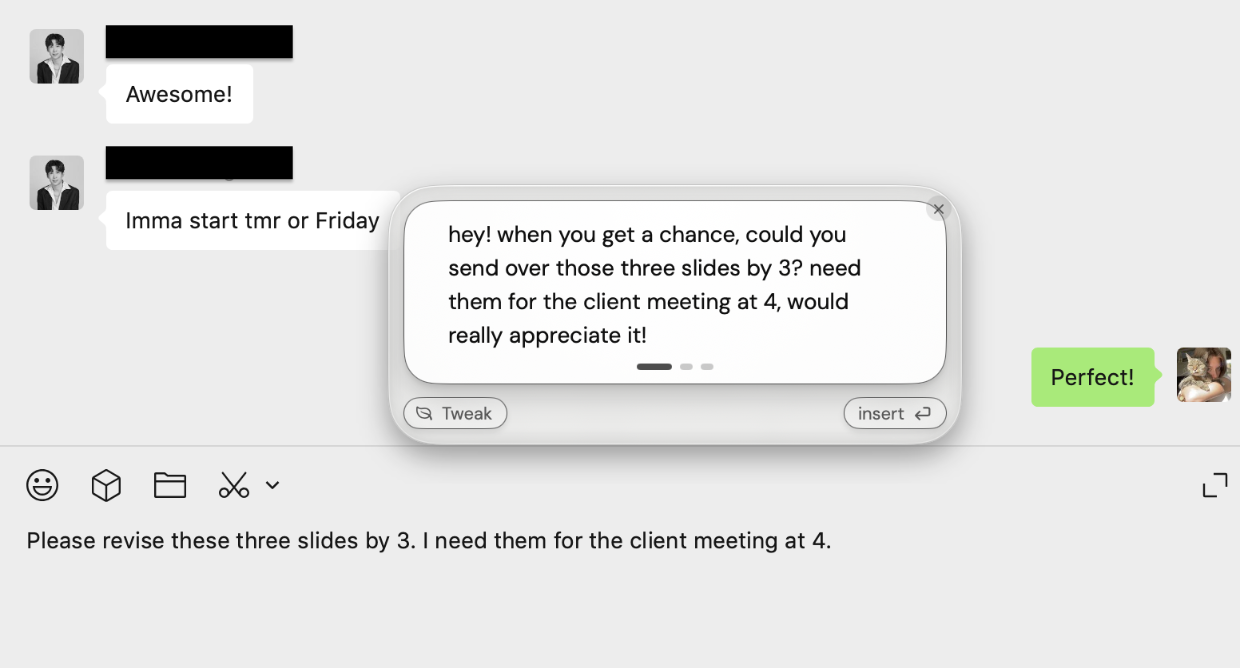
The suggested reply uses “could you” and a warmer closing. It keeps three slides, the 3 o’clock deadline and the client meeting at 4, but changes the action: sending slides does not necessarily mean revising them. “When you get a chance” also leaves more room for interpretation than a firm deadline needs.
A manual edit that preserves the original request would be:
Could you revise these three slides by 3? I need them for the client meeting at 4. Thank you.
Here, “could you” changes the request’s tone while “revise,” three slides, 3 and the meeting at 4 keep the work and timing intact.
To revise a suggestion in ToneBird, choose a draft and use Tweak. For this example, ask: “Keep the request to revise all three slides by 3 and the client meeting at 4. Make the wording more considerate without making the deadline optional.” Check the new wording before using Insert, then review the message in the original field and send it yourself. The support guide explains the controls.
A final check before you send
Read for meaning first: is the request, correction or boundary still the one you intended? Then check how much pressure the wording adds.
An agreed task may need only a clear reminder. New work needs enough context to discuss the burden. A refusal should still say no. If you keep comparing versions that already meet those conditions, use the three checks for overthinking a message to decide whether another edit would help.
Frequently asked questions
Is “Could you” more polite than “Can you” in business English?
“Could you” often sounds a little softer, while “Can you” is common and natural for everyday workplace requests. You do not need to replace every “Can you” with “Could you.” The relationship, request, and context matter more than one phrase.
What if I am not sure whether my message sounds rude?
Read the message once for meaning and once for pressure.
First, make sure the reader can clearly see what you need. Then look for anything that could sound like blame, a command, or unnecessary urgency.
For example:
Why have you not sent this yet?
may feel more confrontational than:
Could you tell me what is holding this up and when it will be ready?
You do not need to remove every direct sentence. The goal is to catch wording that adds more tension than the situation actually requires.

Xinran Zhao has a background in writing and journalism. She writes about the messages we overthink and when AI replies help or miss the point, drawing on her experience starting a career in a second language.