 ToneBird
3 Checks to Stop Overthinking Texts Before You Hit Send
Tell useful edits from repeated second guessing, use three concrete checks and decide when a text is ready to send.
 By Xinran Zhao
 Reviewed & edited byMonica Cheng
When a text is accurate, fits the conversation and makes the next step clear, another edit needs a specific reason. If you have rewritten the same two lines five times, you probably do know what you want to say. What you are looking for is a version that feels completely safe to send.
- Does it say what you mean?
- Does it fit this relationship?
- Is the next step clear?
You change “Sure” to “Sounds good,” add an emoji, remove it, then read the whole thing again because the new version suddenly feels too warm. The message is still saying roughly the same thing, but every edit creates another decision.
Learning how to stop overthinking texts does not mean caring less about how you come across. It means knowing when another edit is actually helping and when you are only trying to remove uncertainty that no sentence can completely remove.
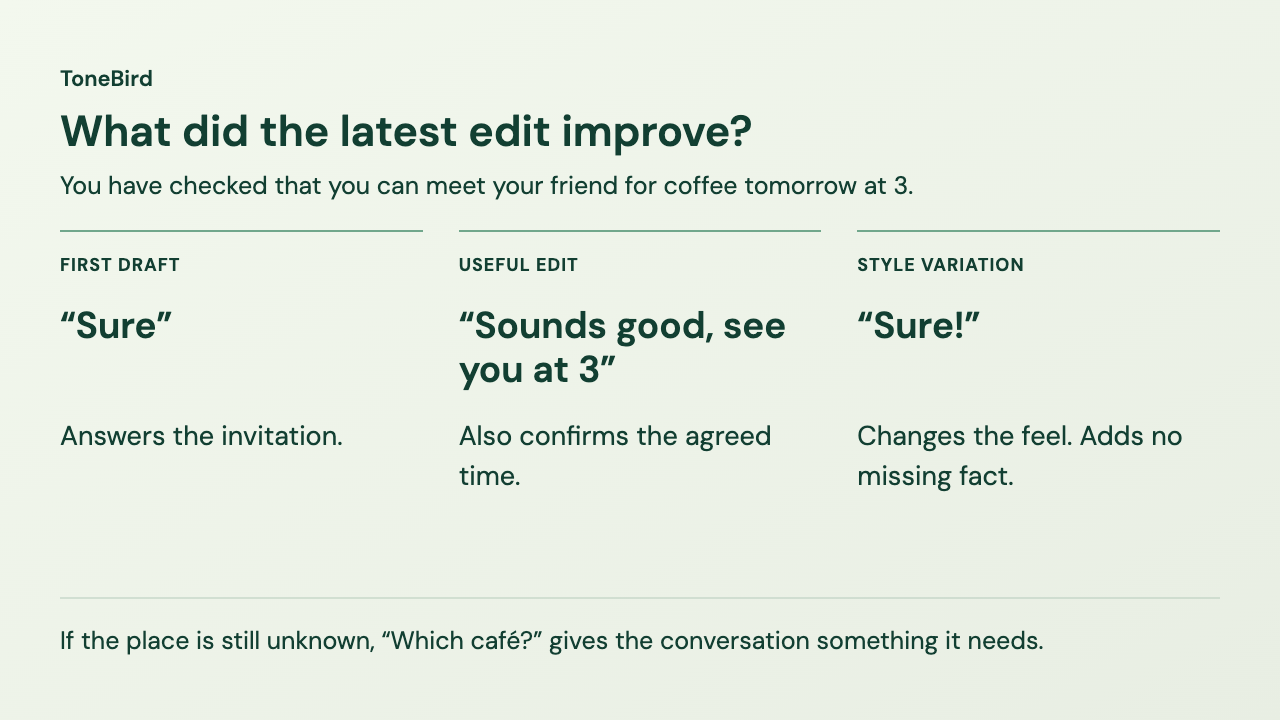
Suppose a friend asks, “Coffee tomorrow at 3?” and you have checked that you can go. “Sure” answers the invitation. “Sounds good, see you at 3” also confirms the time. Once that is settled, swapping back to “Sure!” mostly changes the style. If the meeting place is still unknown, asking “Which café?” adds something the conversation actually needs.
Why do I overthink text messages so much?
A two sentence reply can feel surprisingly heavy because you are rarely deciding only what to say. You may also be deciding how direct to sound, whether this is the right time to reply, what the other person expects from you, and how the message fits the relationship.
That complexity shows up in a qualitative study of 46 instant messaging users. Researchers found that response decisions were shaped by things such as perceived obligation, readiness, personal habits, and the pace of a conversation. The research was not specifically about rewriting messages, but it helps explain why replying can involve much more judgment than simply finding a grammatically correct sentence.
Ambiguity can make that judgment harder. In two studies of university students, higher social anxiety symptoms were associated with more negative interpretations of ambiguous text messages. That does not mean people routinely misunderstand texts. It does suggest that when a message leaves more room for interpretation, there is more material for your mind to keep working on.
That is where useful editing can quietly turn into overthinking. You stop asking whether the message is clear and start asking whether there is some version that guarantees the other person will not think you are rude, distant, needy, awkward, or too formal.
There is rarely a sentence that can guarantee all of that. A more useful question is: What did my latest edit actually improve?
If you have not decided whether to accept, decline or ask for more information, start with working through reply paralysis. The checks below are for a draft whose basic answer is already decided.
Know when editing is still helping
Not every rewrite is unnecessary. Sometimes the second version really is better. The difference is whether you can identify what improved.
Useful editing | Second guessing |
|---|---|
Clarifying what you mean | Replacing one clear phrase with another equally clear one |
Correcting a fact, date, or detail | Rechecking information that is already correct |
Adjusting tone because it does not fit the recipient | Changing the tone back and forth without a specific reason |
Adding a missing question or request | Tweaking punctuation to predict every possible reaction |
Removing wording that could genuinely confuse the reader | Rewriting a message that already says the same thing clearly |
After an edit, ask yourself what became better. If the request is clearer, a detail is now correct, or the tone better fits the person receiving it, the change had a purpose.
If the only answer is “this version feels slightly safer,” pause for a second. If the meaning, accuracy, and relationship fit have not really changed, you may not be improving the message anymore. You may just be creating one more version to compare.
Give the message the attention it needs
Not every message deserves the same amount of review. A quick dinner confirmation and a message asking your manager to move a deadline may both be short, but the consequences are different.
Before editing again, think about what would realistically happen if the wording were slightly imperfect. A casual “Sounds good, see you tomorrow” usually does not need much review. A message involving a deadline, commitment, conflict, or sensitive professional relationship deserves more care.
It also matters how easy a mistake would be to correct. If a friend misunderstands where you want to meet, another text can fix it quickly. If a client misunderstands a price, deadline, or commitment, the consequences may be harder to undo.
The relationship changes the calculation too. Giving difficult feedback, disagreeing with a manager, asking for an extension, or setting a boundary with a client are reasonable moments to slow down. The point is not to treat every message casually. It is to give each one an amount of attention that matches what is actually at stake.
Match the amount of editing to the consequence of the message, not just to how nervous the message makes you feel.
Once you know how much attention the message deserves, you still need a stopping point.
3 checks before you send
Instead of asking whether the message feels perfect, check whether it says what you mean, fits the relationship, and makes the next step clear.
1. Does it say what you mean?
Start with the substance and accuracy. Make sure the other person has the information they need and that dates, availability and commitments are true.
Compare:
I may need more time for the report.
with:
I will not be able to finish the report by Friday. Could I send the final version on Monday instead?
Use the second version when Friday is the agreed deadline and Monday is a date you can offer. If you are still checking, write: “I may need more time for the report. I’ll confirm by 3 today whether Friday is still possible,” only if that check time is realistic. The useful edit supplies your actual status and request; it must not turn uncertainty into a promise. Once the meaning is accurate and complete enough for the situation, swapping individual words may not add much value.
2. Does it fit this relationship?
The same message can sound natural in one relationship and awkward in another. You might be more direct with a close teammate than with a new client or manager, even when the underlying message is identical.
That does not mean professional messages need to sound stiff. It simply means the delivery should make sense for the person receiving it. If the tone clearly does not fit, change it. If it already does, the existence of another possible version is not a reason to keep rewriting.
3. Is the next step clear?
Ask what the other person is supposed to understand or do after reading.
Compare:
I might not be able to make Thursday.
with:
I cannot make Thursday. Would Friday afternoon work instead?
If you know Thursday is impossible and Friday is available, the second version gives the conversation somewhere to go. If Thursday is only uncertain, keep that uncertainty: “I’m checking whether I can make Thursday. Would Friday afternoon also work?” Confirm an alternative only when you have checked it.
When the meaning is clear, the tone fits the relationship, and the next step is understandable, another edit should have a specific reason. If you cannot explain what the next change improves, the message is probably ready.
Use a draft to resolve one wording problem
A useful drafting tool should help you settle the part you are unsure about. If it gives you more versions to compare without changing anything that matters, you can end up with the same problem in a different window.
When you use ToneBird as your AI reply assistant, start with the answer you want to keep. It can draft in supported email and messaging fields, including a first message to a new contact. For an ongoing conversation, available relationship context and your preferred tone can guide the wording without rebuilding the same preferences for each reply.
Click the readable reply field and open the ToneBird bubble. Pick a candidate whose meaning is already right, then identify one thing that needs to change. In the example below, acknowledging a teammate’s plan to rest is enough; you may decide the added joke does not sound like you. If the problem comes from an outdated person note, correct that relationship context instead of polishing around it.
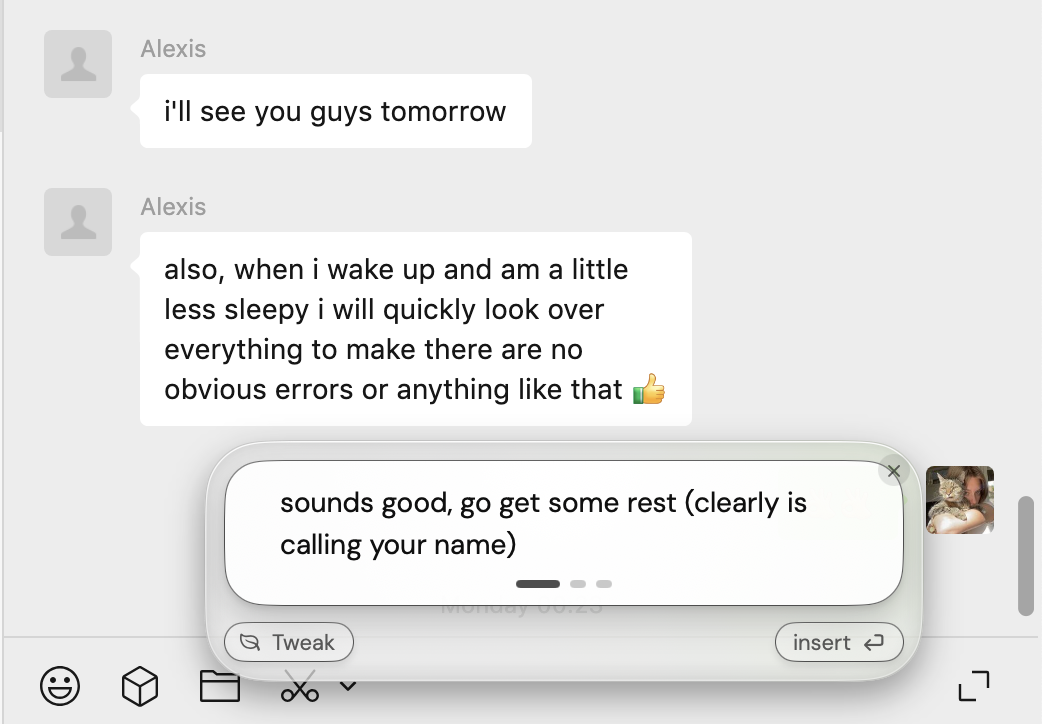
A playful acknowledgment with Tweak and Insert. The parenthetical joke is optional; the acknowledgment still works without it.
A practice instruction for Tweak could be: “Keep the acknowledgment and encouragement to rest. Remove the parenthetical joke.” That is a specific edit with a reason. Asking for five more equally suitable versions can put you back into comparing rather than replying. Use Insert for the version you choose, review it in the original app and send it yourself, as described in the support guide.
You still make the final judgment. Ask the same three questions: does this say what I mean, does it sound right for this person, and is the next step clear? If it does, you do not need to keep rewriting simply because another version is possible.
If you start overthinking after you send
Sometimes the second guessing starts only after the message is gone. You begin wondering whether the period looked annoyed, whether “Sounds good” was too cold, or whether you should send another message just to make the first one feel warmer.
Before fixing anything, ask whether there is actually something to fix. A wrong date, an unclear request, or wording that genuinely changes your meaning is worth fixing. A vague feeling that another version could have sounded slightly better is different.
For the coffee example, a real correction might be: “I meant 3 tomorrow, not 3 today. Does that still work?” That fixes the date and gives the friend a question to answer. Sending a second message just to replace “Sure” with “Sounds good” does not add the same value.
A 2025 study of emotional tone in everyday texts and work or educational emails offers a useful counterpoint to the idea that written messages are constantly being misread. Across both studies, senders and receivers generally aligned on positive versus negative tone. Most messages were positive and the people already knew each other. The findings do not rule out misunderstandings in conflict, unfamiliar relationships or more ambiguous messages.
That does not mean tone is never misunderstood. It does mean that the possibility of misunderstanding is not evidence that one has already happened. If there is a real mistake or a clear misunderstanding, fix it. Otherwise, give the conversation a chance to continue before trying to repair something that may not need repairing.
Finish when the useful work is done
Before another edit, name what it would improve. Correct a fact, clarify the answer or adjust a tone that does not fit. If you cannot identify a change the recipient needs, let the message stand and give the conversation time to continue.
Frequently asked questions
Is overthinking texts the same as texting anxiety?
People use “texting anxiety” to describe worries that can also include waiting for a reply or interpreting someone else’s message. This article focuses on a narrower task: repeatedly editing your own draft. It does not diagnose why that happens. The checks here help you review a message; they are not a treatment for anxiety.
Why do I overthink messages more with certain people?
The relationship may make the consequences feel different. A manager, client or new romantic interest may call for more care than a familiar chat. Check what actually changes the reply: a boundary, a commitment or a level of familiarity. You cannot settle every uncertainty about the relationship through wording alone.
When is it worth asking someone else to check a message?
A second opinion can be useful when the message has meaningful consequences and you are unsure about something specific, such as whether a boundary is clear, whether a request could be misunderstood, or whether important context is missing. It is less useful when you are asking someone to choose between several versions that already communicate the same thing. In that case, another opinion can simply create another round of decisions.

Xinran Zhao has a background in writing and journalism. She writes about the messages we overthink and when AI replies help or miss the point, drawing on her experience starting a career in a second language.