 ToneBird
ChatGPT Alternative for Replies (Tested & Reviewed)
Compare ToneBird and ChatGPT for replies, memory, personal voice, and detailed edits, with original Slack examples and current pricing.
 By Xinran Zhao
ToneBird is a ChatGPT alternative for replies that need the person's history, your usual voice, and earlier unfinished business. Its desktop assistant brings those details into replies and rewrites, then connects conversations with tasks and meeting preparation.
ChatGPT remains a good choice for broader writing and detailed edits. In my work message and personal reply tests, it produced cleaner wording and followed the final editing request more closely. ToneBird's value extends beyond those individual drafts, through its relationship records and reusable preferences.
This ToneBird vs ChatGPT comparison separates those product capabilities from the results I could observe. It also explains ChatGPT's memory and Slack options, which make the choice more useful than a simple app switching comparison. Product details were checked on November 6, 2026.
TLDR
- ToneBird suits ongoing conversations where the recipient, previous agreements, personal voice, and open tasks shape the next reply.
- ChatGPT produced the cleaner work rewrite and followed the final personal reply instructions more closely in these examples.
- ChatGPT has memory and Slack features. The tests below used its separate chat interface and did not evaluate those features.
- Both tools added details that needed review. Check facts and promises before sending either draft.
What is ToneBird?
ToneBird is an AI reply assistant for macOS and Windows. It works beside email and messaging apps, including Gmail, Slack, and WhatsApp.
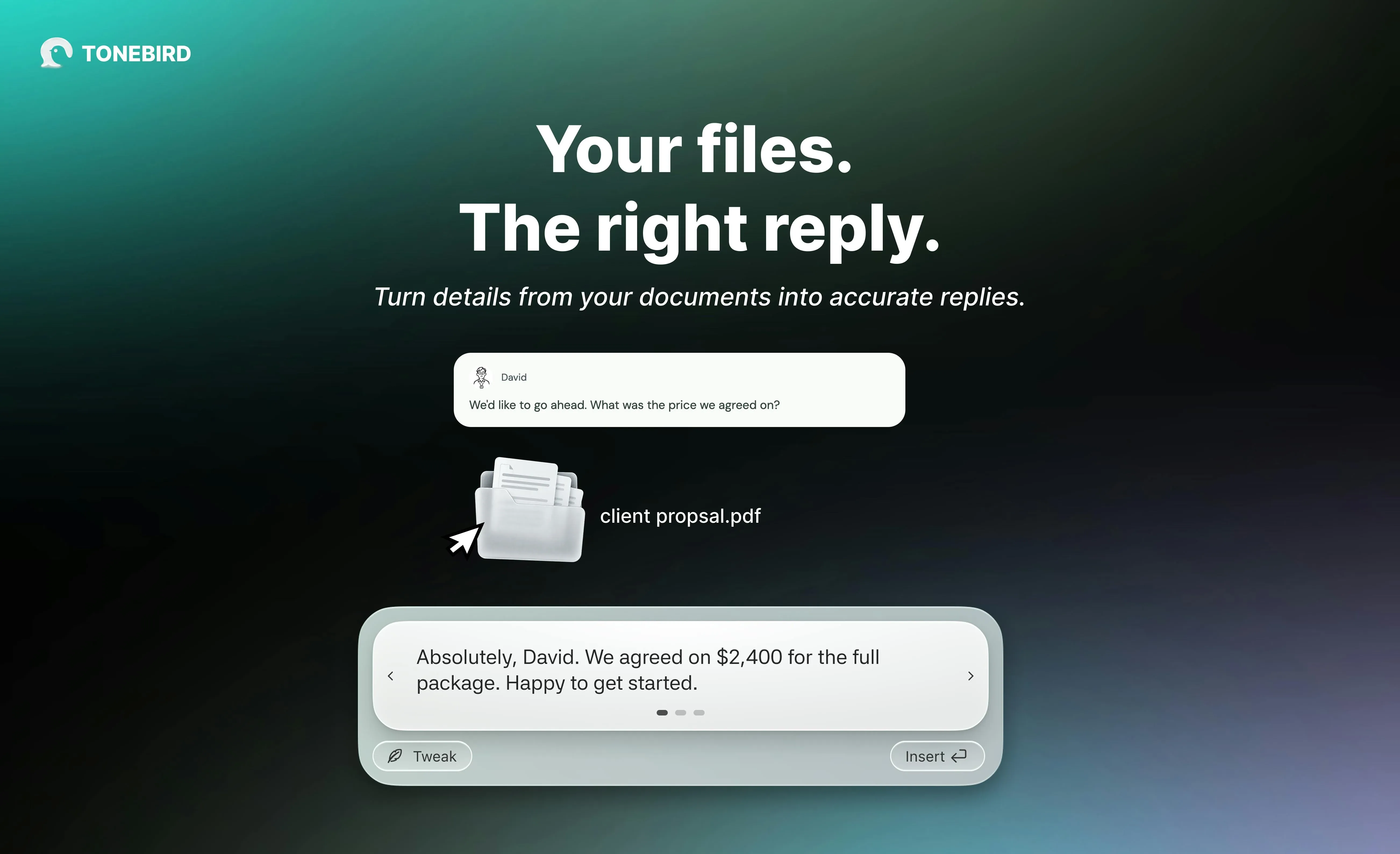
Its purpose is to avoid rebuilding the same background whenever you need help answering someone. The person, previous exchanges, and your preferred wording can all affect the draft.
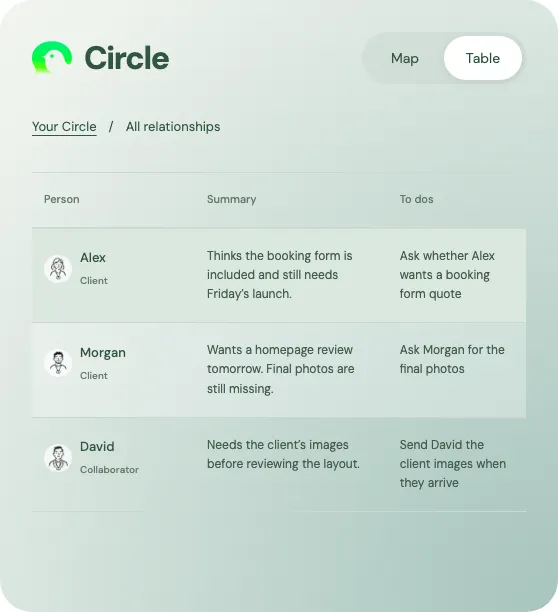
Home brings waiting replies and open tasks together. Circle organizes people, relationships, captured conversations, and related work. Rewind opens the available history for a person.
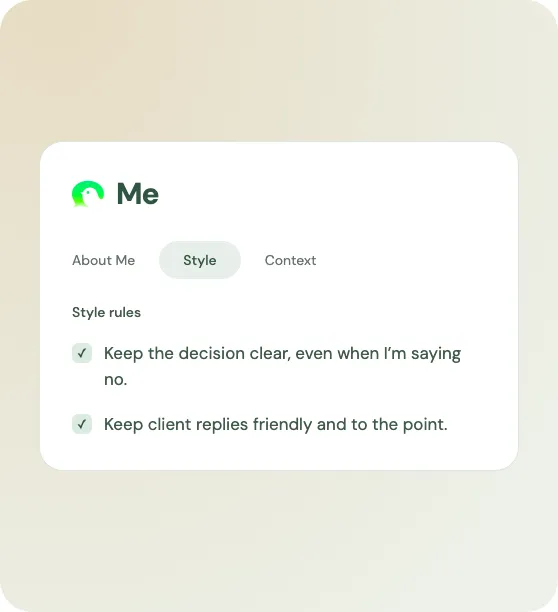
Me holds information about you and your writing preferences. Style provides reusable wording rules and openers. You review suggested learning before applying it to future drafts.
Context holds notes or imported text documents. These can supply facts, such as an agreed fee, that belong in the reply.
Together, these parts support replies with context, rather than a new prompt containing only the latest message.
How does that help an ongoing conversation?
A client asking for extra work needs an answer based on the existing agreement. Their latest request alone may omit that agreement.
Circle and Rewind provide a place to inspect the available person record and history. Your current intention still guides the reply.
Select a candidate, use Tweak to adjust it, then choose Insert. The draft goes into your message box for review and manual sending.
ToneBird can also record conversation tasks and prepare Apple Calendar or Google Calendar events. You check the event details and confirm.
Those capabilities explain its wider conversation workflow. The Slack tests below did not measure memory accuracy or calendar execution over time.
What is ChatGPT?
ChatGPT is OpenAI's general AI assistant. It handles writing, research, file analysis, and other tasks alongside message drafting.
In the chat workflow, you provide a message and explain what you want to say. You can continue editing the answer in that conversation.
ToneBird gives the same reply task a more specific home: the person, available history, writing preferences, and related work.
Memory and previous conversations
ChatGPT's memory can use relevant context to personalize later responses when enabled. Its controls let you review or change what it remembers.
ToneBird organizes relationship records in Circle and writing rules in Me. The relevant question is which background each assistant actually has when drafting.
Starting a fresh ChatGPT chat in my test does not establish that ChatGPT always starts without useful context.
Two different Slack connections
OpenAI documents ChatGPT in Slack and connected Slack access from ChatGPT. These are separate experiences with different setup and permission requirements.
ToneBird's tested route placed suggestions beside the Slack composer. I did not test either OpenAI Slack route, so the screenshots compare different interfaces.
Do not choose solely on the assumption that ChatGPT requires a browser tab for every reply. Check the route available to your account.
How do the conversation workflows compare?
Your task | ToneBird | ChatGPT |
|---|---|---|
Use earlier context | Circle, Rewind, and relevant saved information | Current chat and available memory or connected sources |
Reuse your wording | Me and Style preferences, with reviewed learning | Instructions and available personalization |
Adjust a draft | Compare candidates and use Tweak | Give another instruction in the chat |
Return to the message | Insert, then review and send | Copy in this test; other routes depend on setup |
Carry work forward | Conversation tasks and calendar preparation | Available tools and app connections, depending on access |
Evidence here | Slack drafts and Tweak results | Separate chat drafts and continued edits |
These are workflow differences. A feature's presence does not establish that it will produce a more accurate reply.
Why personal voice needs more than a warmer tone
Me and Style let you reuse your own wording preferences. Tweak handles a change needed only for the current message.
A study of suggested replies reported two randomized experiments with 1,036 participants. Suggestions changed emotional language; perceived AI use was associated with less favorable judgments.
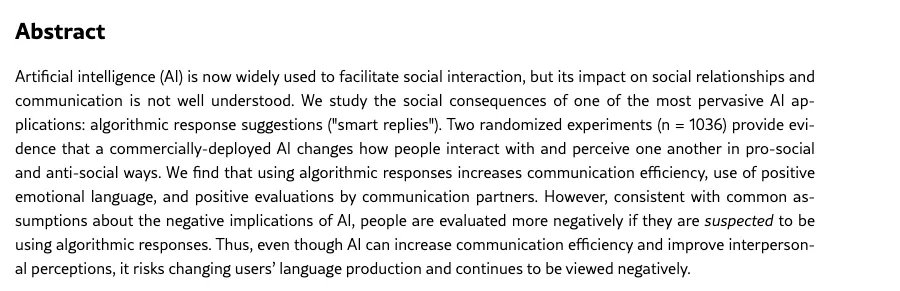
That study examined smart replies, not ToneBird or today's ChatGPT. It helps explain why I check whether a warmer draft still expresses my intention.
Saved context also needs to be relevant. A 2025 customer support study covered 5,172 agents at one firm. AI access raised issues resolved per hour by 15% on average, with different effects across workers.
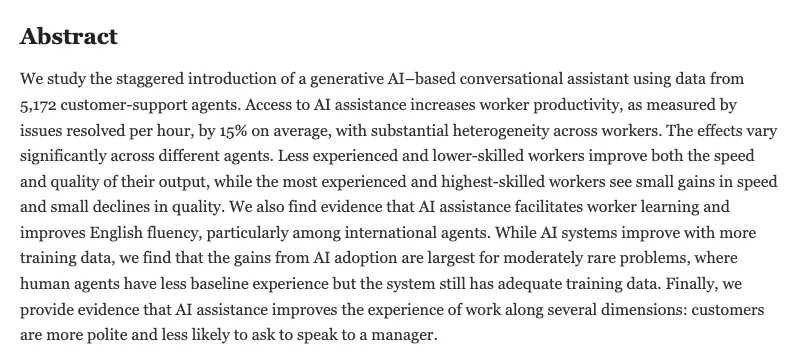
That result concerns a different assistant in customer support. It does not establish a ToneBird speed advantage or prove its memory improves replies.
How I compared the replies
This comparison is published by ToneBird and uses my original test records. The product documentation check is separate from those tests.
I used ToneBird in Slack desktop. For ChatGPT, I started a new conversation for each initial task and used the displayed High setting.
The record does not identify an exact model or subscription. High is the visible setting, not a model name.
ToneBird generated candidates before I used Tweak. ChatGPT received the rewriting request directly. The final refinement also started from different drafts.
These examples show particular outputs and review decisions. They are not a controlled benchmark, a timed test, or a memory evaluation.
Rewriting a blunt work message
The original message was:
I already sent this yesterday. Please check before asking me again.
I wanted friendlier wording while retaining yesterday's delivery and the request to check before asking again.
ChatGPT's rewrite
Hi! I sent this over yesterday. Could you please check the earlier message when you get a chance? Let me know if you have any trouble finding it. Thanks!
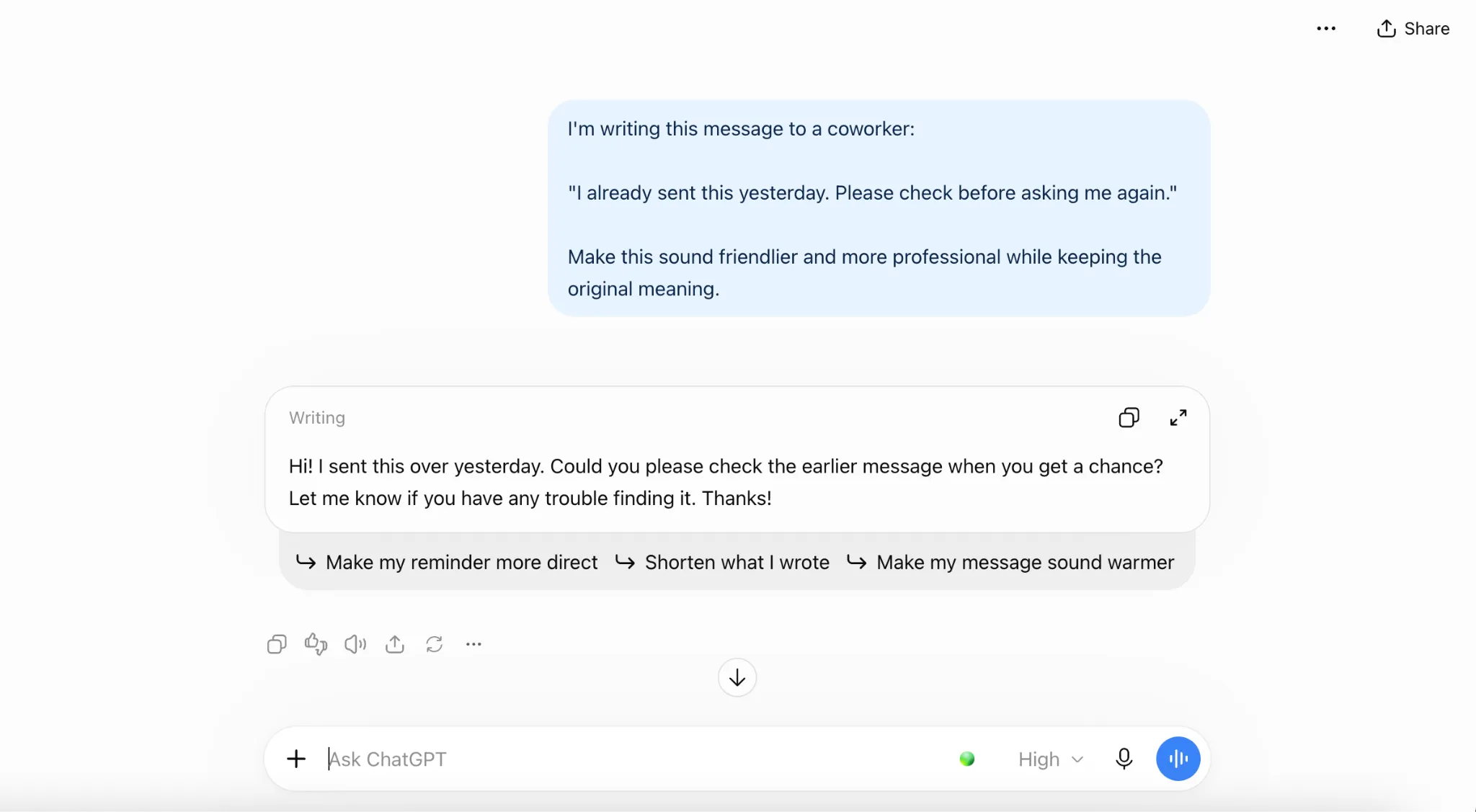
The grammar was clean, and yesterday's delivery remained clear. ChatGPT also offered help finding the message, which I had not offered originally.
I would remove that extra offer if I wanted a shorter reply without another responsibility.
ToneBird's rewrite
ToneBird first suggested:
I did send this yesterday, can you check your messages before following up again?
I then used Tweak:
Make this sound friendlier and more professional while keeping the original meaning.
It returned:
Hey, just wanted to make sure this didn't get buried, I sent a message yesterday, could you take a look when you have a moment?
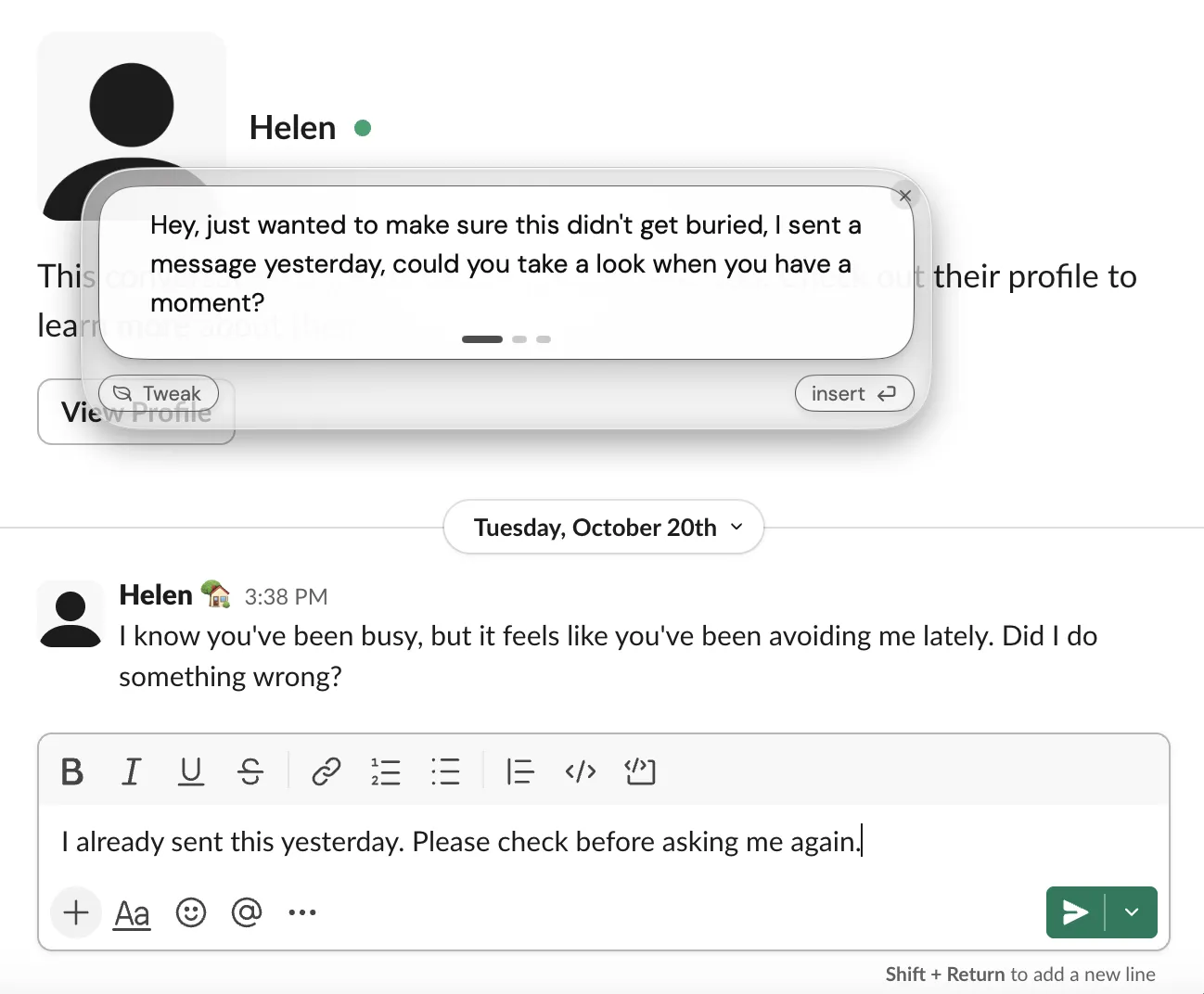
The result sounded more casual. However, it introduced a possible explanation about the message being buried and weakened the original request.
The punctuation also needed work. For this example, I preferred ChatGPT's writing, while still removing its added offer.
My edited version would be:
I sent this yesterday. Could you please check the earlier message before following up?
This is an editorial revision, not another tool output. It keeps the request without adding an explanation or promise.
Replying while asking for personal space
The incoming message said:
I know you've been busy, but it feels like you've been avoiding me lately. Did I do something wrong?
I wanted to express care and explain that I felt overwhelmed. I did not want to promise constant availability.
The first replies
ChatGPT returned:
Hey, no, you didn't do anything wrong at all! I'm sorry if I've made you feel that way. I've just been feeling pretty overwhelmed lately and needed some time to myself. It's nothing personal, and I really do care about you. I might be a little quieter than usual, but I hope you know it's not because of anything you did ❤️
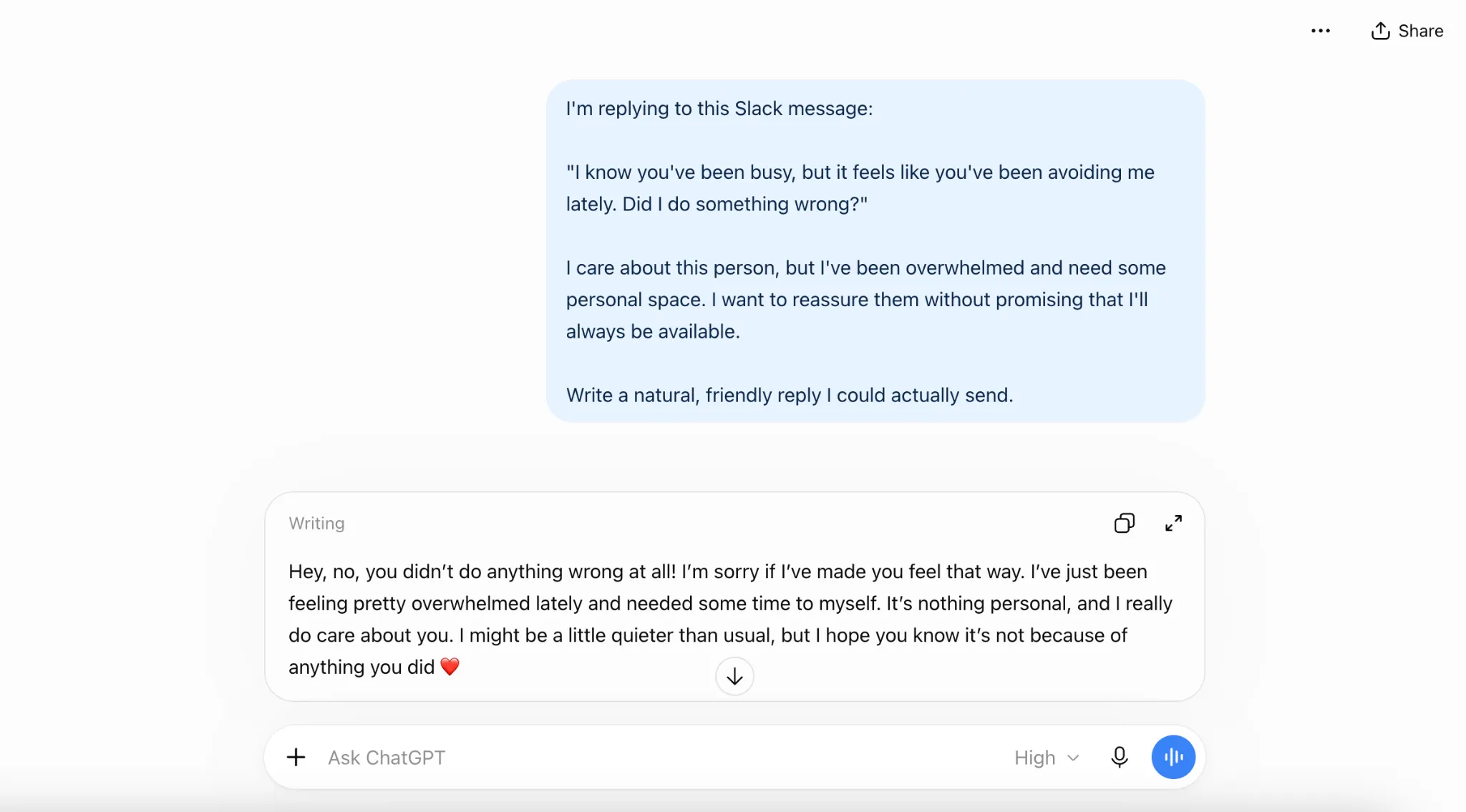
The reply expressed care without naming a date to reconnect. It also assumed the other person had done nothing wrong and added a heart.
Those choices depend on the relationship. I would review both before sending.
After an earlier ToneBird suggestion proposed catching up, I clarified my intention through Tweak. Its revised answer was:
Not at all, you haven't done anything wrong. Things have just been really overwhelming on my end and I've needed some space to breathe, it's not about you at all. I just might not always be as reachable as usual for a bit.
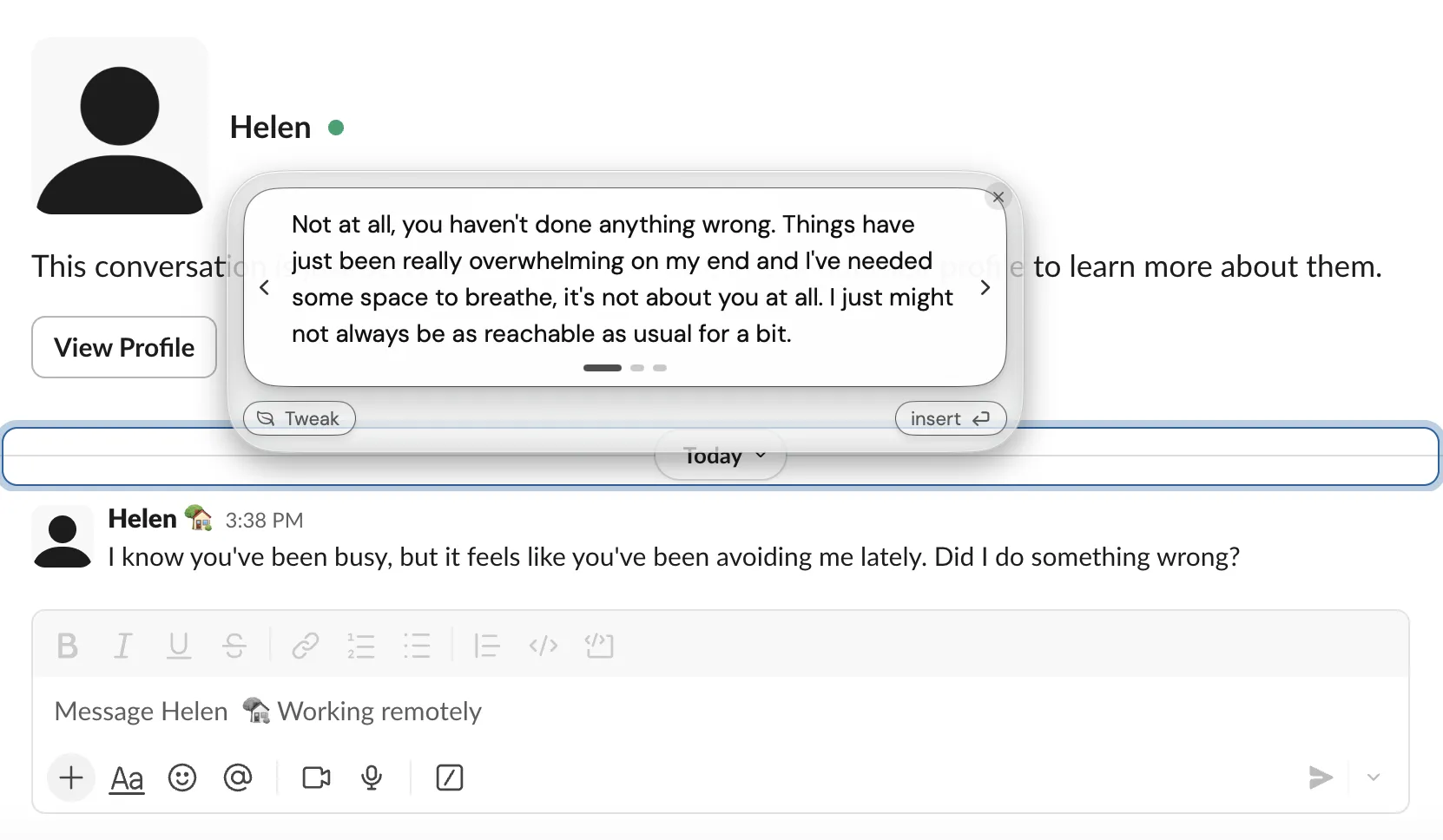
This was shorter and did not propose a meeting. It still made the same reassuring assumption and needed punctuation edits.
Neither draft could establish what had happened between the two people. That judgment belongs to the sender.
A more specific editing request
I gave both tools this instruction:
Make this reply shorter (2–3 sentences) and remove the heart emoji. Don't state as a fact that the other person did nothing wrong. Keep it warm, explain that I need some personal space, and don't promise when I'll reach out again.
ChatGPT revised its reply to:
Hey, I'm sorry if I've made you feel that way. I've just been feeling overwhelmed lately and need a little personal space. I really care about you, and I don't want you to feel like I'm pushing you away.
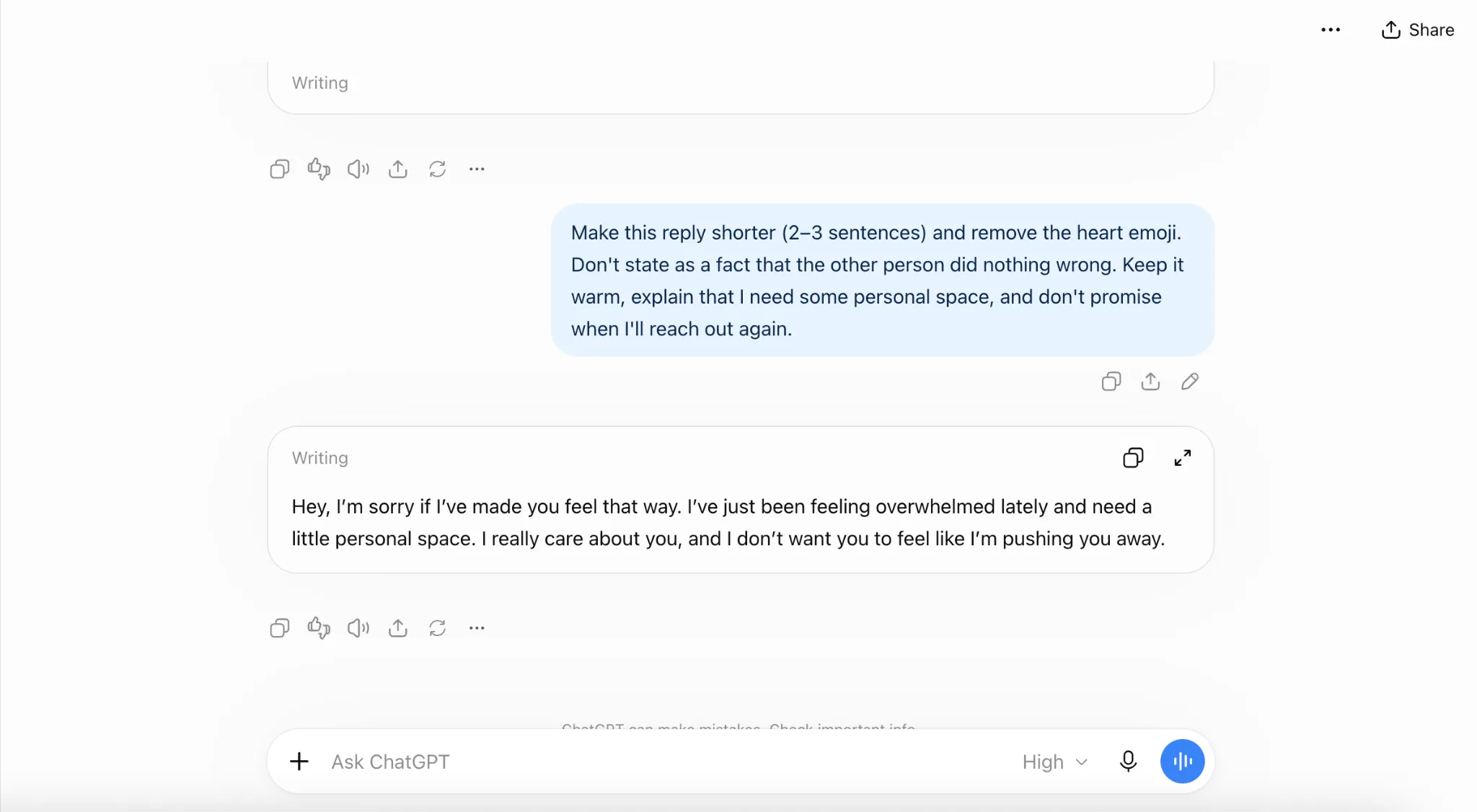
It removed the emoji and the claim that the other person had done nothing wrong. It also avoided a future contact promise.
One captured ToneBird candidate was:
Hey, sorry if it's felt that way, I just need a little personal space right now, nothing to do with you. I'll reach out when things feel right.
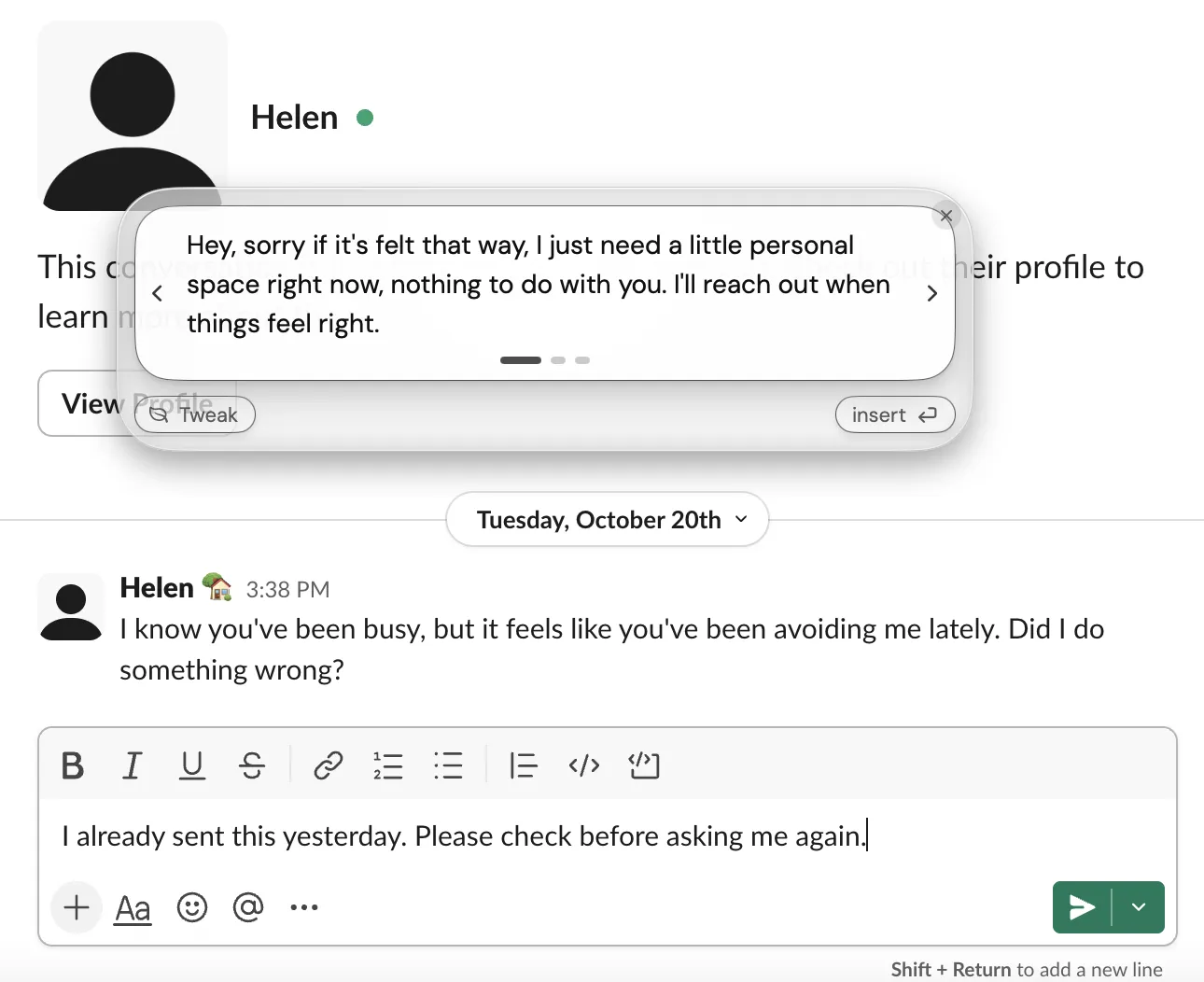
The last sentence created an expectation that I would reach out later. The request forbade promising when, rather than all future contact.
Even so, the added expectation did not match my broader intention. I would also review the claim that it had nothing to do with the recipient.
Check | ChatGPT's final reply | Captured ToneBird candidate |
|---|---|---|
Length | Three sentences | Short text with punctuation to fix |
Unsupported reassurance | Removed the original factual claim | Used a different reassuring claim |
Need for space | Clear | Clear |
Future contact | No promise added | Added an expectation of later contact |
My decision | Closer to the intended reply | Needed another edit |
ChatGPT followed the request more closely in this example. ToneBird offered other candidates, which this record does not evaluate.
How much do they cost?
The following USD prices were checked on November 6, 2026. They cover different products and usage units.
Plan | Monthly billing | Annual billing |
|---|---|---|
ToneBird Standard | $10 per month | $96 per year, equivalent to $8 per month |
ToneBird Pro | $40 per month | $384 per year, equivalent to $32 per month |
ChatGPT Plus | $20 per month | OpenAI's Plus help page lists monthly billing |
Sources: ToneBird pricing and ChatGPT Plus.
ToneBird Standard includes 100 daily uses and 100 contacts. Pro includes 1,000 daily uses and 1,000 contacts. Both products also offer free access.
ToneBird's site says paid checkout is not yet available there. ChatGPT's limits depend on the plan and feature; they are not daily reply counts.
What happens to conversation data?
ToneBird's privacy overview distinguishes local saved records from model processing. Context needed for generation goes to the selected provider.
Local storage does not mean every reply is generated offline. Review permissions, stored memories, and provider settings before using sensitive material.
ChatGPT memory and connected apps have their own controls. Check which context is enabled and the audience before using it in a shared Slack conversation.
Which would I choose?
I would use ToneBird when ongoing relationships, my usual voice, and unfinished work should shape the next reply. Its tasks and meeting preparation make that choice broader than rewriting one sentence.
I would use ChatGPT for broader writing or detailed edits like the final personal reply here. Its stronger result deserves to remain part of the comparison.
For a draft you already have, try ToneBird's email rewriter. For an incoming message, its AI response generator starts from that reply task.
Those web tools use the input you provide. The complete desktop assistant adds the ongoing relationship and personal voice workflow described above.
Common questions
Can ChatGPT write replies to text messages?
Yes. Give it the incoming message, relevant facts, and your intention. In my tests, it also handled further edits within the same conversation.
Does a new ChatGPT chat always forget the context?
No. Available memory can influence new replies when enabled. My fresh chat setup does not establish the limits of ChatGPT's memory.
Can ChatGPT work inside Slack?
OpenAI documents a Slack conversation experience and a connected Slack app in ChatGPT. Check your account and workspace setup; I tested neither here.
Does ToneBird send replies automatically?
No. Insert places the draft in your message box. You check it and send it from the original app.
Does ToneBird remember people and earlier conversations?
Circle and Rewind organize available person records and captured history. These examples did not measure how complete or accurate those records remain over time.
Can ToneBird help with tasks and meetings?
It can record conversation tasks and prepare calendar events for confirmation. Preparing an event and confirming it are separate actions.
Which tool is better at keeping personal boundaries?
Check the actual draft. ChatGPT's final answer was closer in this example, but both tools added assumptions in earlier replies.
Can I use both tools?
Yes. ToneBird can support continuing conversations, while ChatGPT handles a draft needing deeper editing or other work. Review the facts in either result.

Xinran Zhao has a background in writing and journalism. She writes about the messages we overthink and when AI replies help or miss the point, drawing on her experience starting a career in a second language.